Show all news
  • BRC
  • Certification
  • Food Safety
  • IFS
  • ISO 22000
  • Large-scale retail

BRC, IFS and ISO 22000: differences between food certifications
12 GP NEWS ANDREA FS ENG 25
Mar 10, 2026
2 minutes

For companies operating in the food sector, certification is a key tool to demonstrate reliability, regulatory compliance, and the ability to ensure high safety standards throughout the entire production chain.

Among the most widely adopted schemes are BRC, IFS and ISO 22000, three international standards that enable companies to structure and improve their food safety management systems.

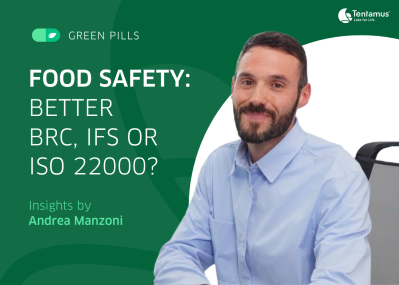
In the new video of the Green Pills series, Andrea Manzoni – Food Safety & Quality Specialist at Pegaso Management, explains the main differences between these standards and when it may be appropriate to adopt them.

Follow our channels to stay updated on upcoming content dedicated to food safety and sustainability.

WATCH THE VIDEO 👇

BRC and IFS: certifications for working with large-scale retail

BRC and IFS standards are often required by large-scale retail chains (GDO), which use them as a benchmark to qualify their suppliers.

Both schemes include structured audits and strict requirements related to:

  • food safety
  • production process management
  • supplier control
  • product traceability
  • non-conformity management

Their geographical diffusion shows some differences:

  • BRC is particularly widespread in Anglo-Saxon markets.
  • IFS is more common in Central European countries.


ISO 22000: a system-based approach to food safety

The ISO 22000 standard represents a true food safety management system, built according to the structure of ISO standards.

This allows companies to easily integrate it with other management systems already in place, such as those for quality or environmental management.

The ISO approach therefore makes it possible to develop a more flexible organizational model focused on continuous improvement.


How we can support you

Pegaso Management supports companies in the agri-food sector through technical consulting in:

We Value Your Privacy
We use cookies on our website. Some of them are essential, while others help us to analyze how this website is being used and to allow you to contact us through our website, i.e. use the chat widget. You can change your decision at any time.
We Value Your Privacy
Statistics
We use these technologies to analyze how this website is being used.
Name Google Analytics, Google Tag Manager
Provider Google Ireland Limited, Gordon House, Barrow Street, Dublin 4, Ireland
Purpose Cookie by Google used for website analytics. Generates statistical data on how the visitor uses the website.
Privacy Policy https://policies.google.com/privacy
Cookie Name _ga, _gat, _gid
Cookie Expiry 2 years
Name Salesforce Marketing Cloud Account Engagement
Provider Salesforce, Inc. Salesforce Tower, 415 Mission Street, 3rd Floor, San Francisco, CA 94105, United States
Purpose Tracks visitor and prospect activities on our website pages by setting cookies on the browser.
Privacy Policy Link
Cookie Name visitor_id1109552, pi_opt_in1109552, visitor_id1109552-hash, lpv1109552, pardot
Cookie Expiry 2 years
Customer Interaction
These technologies will allow you to contact us through our website, i.e. use the chat widget.
Name LiveChat
Provider LiveChat Software S.A., ul. Zwycięska 47, 53-033 Wroclaw, Poland
Purpose Communication with clients via online chat using the API of the chat service LiveChat.
Privacy Policy https://www.livechat.com/legal/privacy-policy/
Cookie Name __lc_cid, __lc_cst
Cookie Expiry 2 years
Essential
Technologies required to enable the core functionality of this website.
Name Cookie Consent
Provider Owner of this website, [imprint_link]
Purpose Saves the visitors preferences selected in the cookie banner.
Cookie Name ws_cookie_consent
Cookie Expiry 1 year